Many facility users have come to expect easy access to paper, plastic and glass recycling bins as a given. But food waste is the stream that businesses are still catching up on - and recent legislation means you can't afford to fall behind.
Since 31 March 2025, Simpler Recycling legislation has required all non-domestic premises in England to separate food waste, paper and card, mixed recycling (glass, metal and plastic), and general waste for collection. This applies across every commercial sector: offices, hotels, restaurants, schools, hospitals, warehouses, manufacturing facilities, retail outlets, and care homes. Micro-firms with fewer than ten full-time equivalent employees have until 31 March 2027, but for most businesses, the obligation is already in force.
The environmental repercussions of getting food waste management wrong remain substantial. And now there are legal and financial ones too. Here is what your facility needs to know.
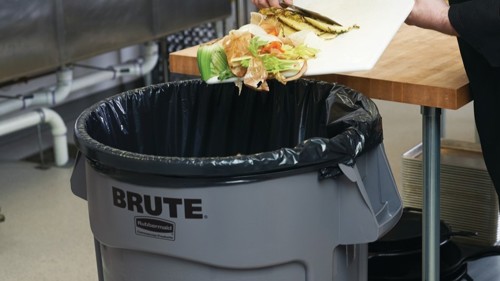
The reality of food waste
Food waste alone generates 8 to 10% of global greenhouse gas emissions, and roughly a third of food produced worldwide is lost or wasted.1
When food is sent to general waste it becomes a wasted resource and an avoidable cost. But when collected and processed correctly, food waste can be converted into fertiliser for agriculture or used as a renewable energy source through anaerobic digestion.
food waste GOES BEYOND COMMERCIAL KITCHENS
It is easy to frame food waste as a hospitality or catering issue. The reality is different. In every sector, employees generate personal waste, and in particular food waste, throughout the working day: packed lunches in office break rooms, snacks on warehouse floors, drinks in retail back-of-house areas, leftovers in manufacturing canteens.
If employees have no clearly marked, accessible food waste container nearby, it inevitably ends up in the general waste bin. Mixed waste is harder to process, more likely to be rejected by collection contractors, and now more likely to create problems in the waste chain as digital record-keeping becomes mandatory across the sector.
The Simpler Recycling rules make clear that all workplaces must provide separate food waste collection, regardless of whether they have a formal catering operation. That means the right containers, in the right places, clearly signed. Not just in the kitchen.
THE RIGHT CONTAINER FOR THE JOB
Getting the physical infrastructure right is the foundation of an effective food waste system. Our waste management range includes containers suited to food waste collection across different environments.
BRUTE® containers are ideal for back-of-house and high-volume environments. Robust, easy to clean, and designed to handle demanding conditions, BRUTE® is a reliable option for kitchens, canteens, loading areas, and waste stores where food waste volumes are significant.
Slim Jim® Step-On containers offer a hands-free, hygienic solution for environments where cross-contamination is a risk. Available in resin and stainless steel finishes, they work well in food preparation areas, break rooms, and customer-facing spaces. The pedal-operated lid also ensures that any food odours stay contained.
Slim Jim® Recycling Stations are designed to bring multiple recycling streams together in a single unit, without taking up excessive floor space. They are built to fit into tight commercial spaces, combining clear stream identification with a compact footprint.
Elite™ Dual Stream is a compact pedal-operated container from our Rubbermaid Range, which has a sleek stainless steel look for front-of-house areas, with rigid containers to separate waste streams
All containers are available in colourways aligned to UK colour-coding conventions, with visible signage to direct facility users to the correct stream. Using our Label Customisation Tool, you can also choose custom icons for your labels (including food waste options) to suit your venue.
digital waste tracking: what it means for your facility and food waste
The UK Government's Digital Waste Tracking Service is changing how waste movements are recorded across the country. In practical terms, it means that the sites which receive your waste will be required to digitally track what they receive, including waste type and how it is processed.
When food waste is mixed with dry recyclables, or general waste is contaminated with food, the load that arrives at a receiving site is harder to classify and process. Under digital tracking, receiving sites must record what arrives. A contaminated load is a recorded problem - one that creates compliance risk for the waste contractor and, ultimately, reflects on the businesses sending it.
Better in-facility separation, before waste leaves your building, helps to reduce contamination in the waste chain. Clearly labelled multi-stream containers make that separation possible in practice, across every shift and every team.
NOT SURE WHERE TO START?
Getting your food waste system right across a whole facility takes more than putting a bin in the break room. The right number of containers, in the right locations, clearly signed and regularly emptied, is what makes a system work in practice.
Use our free 'waste walk' checklist for hospitality venues to assess where different types of waste are being generated in your venue, and identify where bins need to go.
Or speak to our team to find out how RCP can help optimise your waste management strategy.
1 UN Environment Programme, Food Waste Index Report 2021, and FAO, 2011
Share on Social Media
